
Daily duas are short supplications from the Quran and the Sunnah that Muslims read at set moments of the day: waking up, eating, leaving home, studying, and going to sleep. Each one takes only a few seconds, yet it turns an ordinary routine into an act of worship. This guide collects the most important daily duas in one place, with the Arabic text, transliteration, English meaning, Urdu tarjuma and the exact source, so you can learn them yourself and teach them to kids at home.
Bookmark this page. It is our hub for every dua article on BlogsFussion, and we add new duas to it regularly.

Daily Duas at a Glance
Use this quick table to find the right dua for each moment of your day. Full text and meanings are given in the sections below.
| When to read | Dua (transliteration) | Source |
|---|---|---|
| After waking up | Alhamdu lillahil-ladhi ahyana ba’da ma amatana wa ilayhin-nushur | Sahih al-Bukhari 6324 |
| Before sleeping | Bismika Allahumma amutu wa ahya | Sahih al-Bukhari 6324 |
| Before eating | Bismillah | Abu Dawud 3767, Tirmidhi 1858 |
| If you forget Bismillah | Bismillahi awwalahu wa akhirahu | Abu Dawud 3767, Tirmidhi 1858 |
| After eating | Alhamdu lillahil-ladhi at’amani hadha wa razaqanihi min ghayri hawlin minni wa la quwwah | Abu Dawud 4023, Tirmidhi 3458 |
| Leaving home | Bismillahi tawakkaltu ‘alallah, wa la hawla wa la quwwata illa billah | Abu Dawud 5095, Tirmidhi 3426 |
| Before studying | Rabbi zidni ‘ilma | Quran 20:114 |
| For parents | Rabbir-hamhuma kama rabbayani saghira | Quran 17:24 |
| Any time (all-in-one dua) | Rabbana atina fid-dunya hasanah wa fil-akhirati hasanah wa qina ‘adhaban-nar | Quran 2:201 |
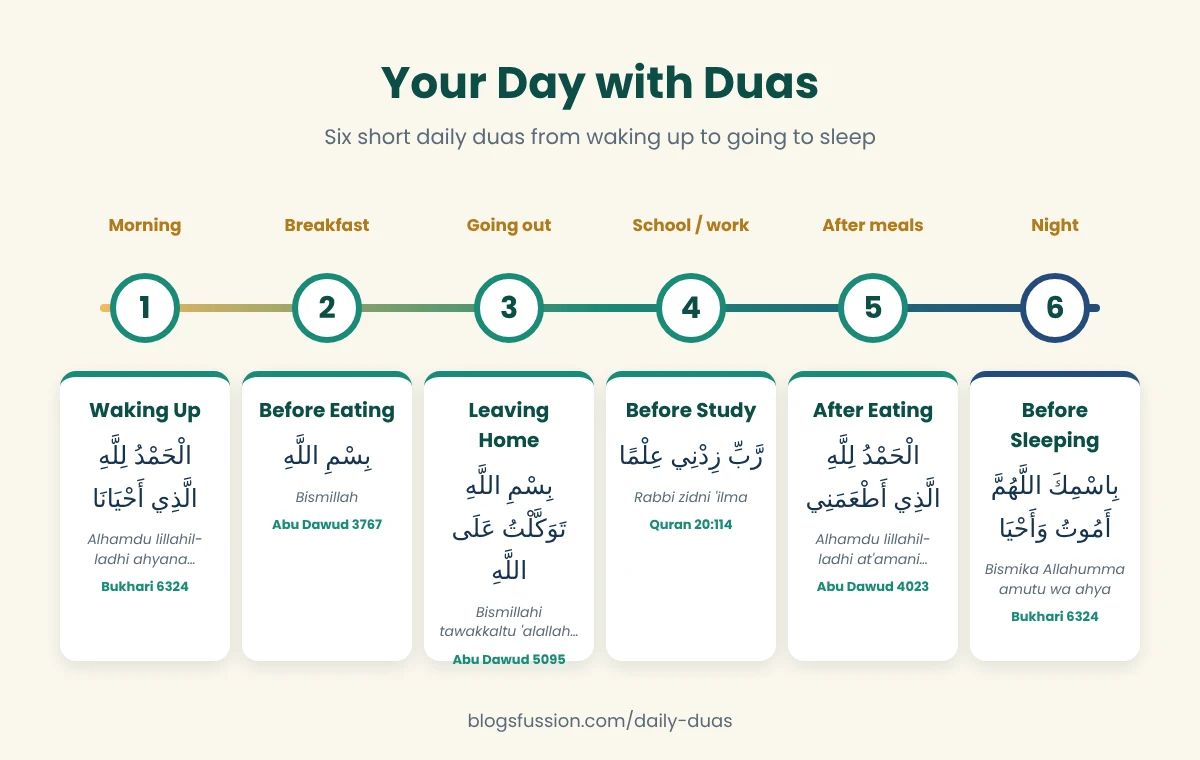
Your Day with Duas (Diagram)
This diagram shows where six of the most common daily duas fit into an ordinary day, from the moment you wake up until you go to bed.
Morning Duas: When You Wake Up
The first words of the day set its tone. The Prophet (peace be upon him) began each morning by thanking Allah for returning his soul after sleep.
Dua After Waking Up
الْحَمْدُ لِلَّهِ الَّذِي أَحْيَانَا بَعْدَ مَا أَمَاتَنَا وَإِلَيْهِ النُّشُورُ
Transliteration: Alhamdu lillahil-ladhi ahyana ba’da ma amatana wa ilayhin-nushur
English meaning: All praise is for Allah, who gave us life after He caused us to die, and to Him is the return.
Urdu tarjuma:
تمام تعریفیں اللہ کے لیے ہیں جس نے ہمیں موت (نیند) کے بعد زندگی دی، اور اسی کی طرف لوٹ کر جانا ہے۔
Reference: Sahih al-Bukhari 6324
Want more morning duas and wishes to send to family? Read our full guide: Good Morning Dua: 80+ Islamic Duas & Wishes.
Night Duas: Before Sleeping
Sleep is called the “minor death” in Islam. That is why the bedtime dua and the waking dua mirror each other.
Dua Before Sleeping
بِاسْمِكَ اللَّهُمَّ أَمُوتُ وَأَحْيَا
Transliteration: Bismika Allahumma amutu wa ahya
English meaning: In Your name, O Allah, I die and I live.
Urdu tarjuma:
اے اللہ! تیرے ہی نام کے ساتھ میں مرتا (سوتا) ہوں اور جیتا (جاگتا) ہوں۔
Reference: Sahih al-Bukhari 6324
Duas for Eating and Drinking
Starting a meal with Allah’s name and ending it with thanks are two of the easiest sunnahs to teach kids, because they happen three times a day.
Dua Before Eating
بِسْمِ اللَّهِ
Transliteration: Bismillah
English meaning: In the name of Allah.
Urdu tarjuma:
اللہ کے نام سے (شروع کرتا ہوں)۔
Reference: Sunan Abu Dawud 3767, Jami’ at-Tirmidhi 1858
If You Forget to Say Bismillah
بِسْمِ اللَّهِ أَوَّلَهُ وَآخِرَهُ
Transliteration: Bismillahi awwalahu wa akhirahu
English meaning: In the name of Allah, at its beginning and at its end.
Urdu tarjuma:
اللہ کے نام سے، اس کے شروع میں بھی اور آخر میں بھی۔
Reference: Sunan Abu Dawud 3767, Jami’ at-Tirmidhi 1858
Dua After Eating
الْحَمْدُ لِلَّهِ الَّذِي أَطْعَمَنِي هَذَا وَرَزَقَنِيهِ مِنْ غَيْرِ حَوْلٍ مِنِّي وَلَا قُوَّةٍ
Transliteration: Alhamdu lillahil-ladhi at’amani hadha wa razaqanihi min ghayri hawlin minni wa la quwwah
English meaning: All praise is for Allah, who fed me this and provided it for me without any power or strength on my part.
Urdu tarjuma:
تمام تعریفیں اللہ کے لیے ہیں جس نے مجھے یہ کھانا کھلایا اور میری کسی طاقت اور قوت کے بغیر مجھے یہ رزق عطا کیا۔
Reference: Sunan Abu Dawud 4023, Jami’ at-Tirmidhi 3458
Dua When Leaving Home
Whether you are going to school, work or the market, this short dua places your day in Allah’s care.
Dua for Leaving the House
بِسْمِ اللَّهِ تَوَكَّلْتُ عَلَى اللَّهِ، وَلَا حَوْلَ وَلَا قُوَّةَ إِلَّا بِاللَّهِ
Transliteration: Bismillahi tawakkaltu ‘alallah, wa la hawla wa la quwwata illa billah
English meaning: In the name of Allah, I place my trust in Allah, and there is no power and no strength except with Allah.
Urdu tarjuma:
اللہ کے نام سے (نکلتا ہوں)، میں نے اللہ پر بھروسہ کیا، اور اللہ کے سوا نہ کوئی طاقت ہے نہ کوئی قوت۔
Reference: Sunan Abu Dawud 5095, Jami’ at-Tirmidhi 3426
Duas for Study, Exams and Knowledge
This is the only place in the Quran where Allah tells the Prophet to ask for “more” of something, and that something is knowledge.
Dua for Increase in Knowledge
رَّبِّ زِدْنِي عِلْمًا
Transliteration: Rabbi zidni ‘ilma
English meaning: My Lord, increase me in knowledge.
Urdu tarjuma:
اے میرے رب! میرے علم میں اضافہ فرما۔
Reference: Quran, Surah Taha 20:114
For 15 more duas for students, an exam day routine and a study timetable, read Dua for Exam: 15 Powerful Quran & Sunnah Duas for Success.
Duas for Parents and Family
Dua for Parents
رَّبِّ ارْحَمْهُمَا كَمَا رَبَّيَانِي صَغِيرًا
Transliteration: Rabbir-hamhuma kama rabbayani saghira
English meaning: My Lord, have mercy upon them as they brought me up when I was small.
Urdu tarjuma:
اے میرے رب! ان دونوں پر رحم فرما جیسے انہوں نے بچپن میں میری پرورش کی۔
Reference: Quran, Surah Al-Isra 17:24
More family duas on BlogsFussion:
- Dua for New Born Baby: 12 Quran and Sunnah Duas (Boy and Girl)
- 80+ Islamic Wishes for a New Mother with Duas
- Islamic Birthday Wishes for Family
- Islamic Birthday Wishes and Prayers
- 40th Birthday Wishes with Islamic Dua
One Dua for Every Need
If you can memorise only one dua, many scholars recommend this one. It asks for good in this world and the next, and it was among the duas the Prophet (peace be upon him) made most often (Sahih al-Bukhari 6389).
Rabbana Atina Dua
رَبَّنَا آتِنَا فِي الدُّنْيَا حَسَنَةً وَفِي الْآخِرَةِ حَسَنَةً وَقِنَا عَذَابَ النَّارِ
Transliteration: Rabbana atina fid-dunya hasanah, wa fil-akhirati hasanah, wa qina ‘adhaban-nar
English meaning: Our Lord, give us good in this world and good in the Hereafter, and protect us from the punishment of the Fire.
Urdu tarjuma:
اے ہمارے رب! ہمیں دنیا میں بھی بھلائی عطا فرما اور آخرت میں بھی بھلائی عطا فرما، اور ہمیں آگ کے عذاب سے بچا۔
Reference: Quran, Surah Al-Baqarah 2:201
Islamic Wishes and Duas for Special Occasions
Beyond daily routines, Muslims share duas on blessed days and life events. These guides pair each greeting with a matching dua:
| Occasion | Guide |
|---|---|
| Every Friday | Jumma Mubarak Wishes and our free Jumma Mubarak Card Maker |
| Ramadan | Ramadan Mubarak Wishes for Family |
| Shab e Barat | Shab e Barat Mubarak Wishes & Duas |
| Islamic New Year | Islamic New Year Wishes with Duas |
| Eid Milad un Nabi | Eid Milad un Nabi Wishes |
| Nikah | Nikah Mubarak Wishes & Duas |
| Hajj | Hajj Mubarak Wishes for Parents |
| Umrah | Umrah Mubarak Wishes for Mother |
| Loss of a loved one | Islamic Condolence Messages |
| Any blessing | May Allah Bless You Wishes & Quotes |
How to Make Daily Duas a Habit
- Start with three. Learn the waking, eating and sleeping duas first. They repeat every day, so they stick fast.
- Link each dua to an action. Say the leaving-home dua with your hand on the door; say Bismillah as you pick up the spoon.
- Learn the meaning, not just the words. Reading the English or Urdu meaning once makes the Arabic feel personal.
- Teach kids by example. Kids copy what they hear. Say the dua aloud at the table and at bedtime.
- Add one new dua each week. In a few months you will know every dua on this page.
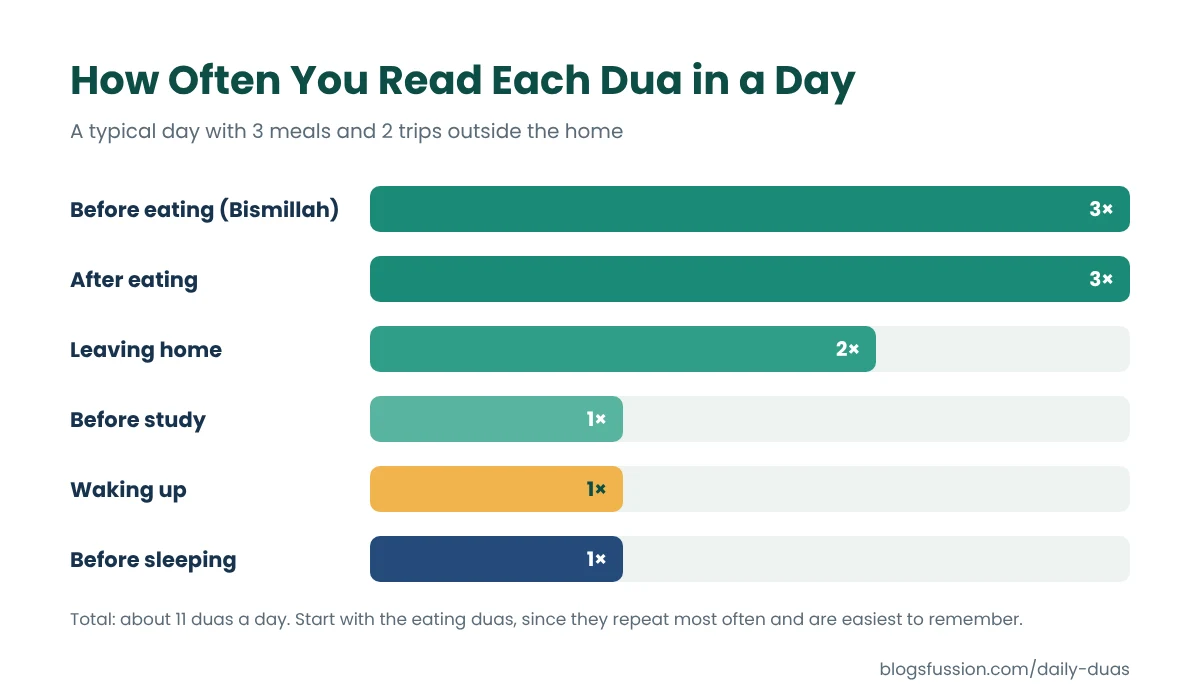
Which Duas Do You Read Most Often?
In a typical day with three meals and two trips outside, you read the eating duas six times. That is why they are the best duas to learn first.
Etiquette of Making Dua
- Begin by praising Allah and sending salawat on the Prophet (peace be upon him).
- Ask with certainty and a present heart.
- Be patient. The Prophet said a person’s dua is answered as long as he does not become hasty and say, “I prayed but was not answered” (Sahih al-Bukhari 6340).
- Make dua for others too, not only for yourself.
Frequently Asked Questions
What are the most important daily duas?
The core daily duas are the duas for waking up, sleeping, eating (before and after) and leaving home. Together with Rabbana Atina (Quran 2:201), they cover every part of an ordinary day.
Can I read daily duas in English or Urdu?
Yes. You can make personal dua in any language. However, it is best to learn the original Arabic wording of duas from the Quran and Sunnah, and to understand their meaning in your own language.
Is wudu required to read daily duas?
No. Daily duas such as the eating, sleeping and leaving-home duas can be read without wudu.
How can I teach daily duas to kids?
Teach one short dua at a time, attach it to a daily action, say it aloud together, and praise them when they remember it. Bedtime and mealtimes are the best moments to practise.
Where can I verify the Arabic text of these duas?
Every dua on this page lists its source. You can check Quran references on quran.com and hadith references on sunnah.com.
